World Cup 2010 in South Africa: From Soccer City to Iniesta's Goal

The 2010 World Cup ran from 11 June to 11 July in South Africa, the first time the tournament had been played on the African continent. Thirty-two teams, ten stadiums in nine cities, 64 matches and 145 goals, which works out at 2.27 a game, one of the lower averages of the modern era. Most people who watched it remember the sound before they remember any match.
The sound of the vuvuzela
The vuvuzela is a plastic horn, typically around 65 centimetres long, and in South African stadiums it was already part of the furniture long before 2010. Played by tens of thousands of people at once it produces a steady drone in the region of a B flat, and on television that drone sat underneath every commentary for a month. Broadcasters received complaints, players said they could not hear each other on the pitch, and there was talk of a ban. The horns stayed. For a generation of viewers the tournament has a soundtrack nobody chose.
Jabulani, the ball everyone blamed
Adidas supplied the match ball, the Jabulani, built from eight thermally bonded panels instead of the stitched patchwork of older designs. Goalkeepers complained that it moved in the air in ways they could not read, and several outfield players said the same about long passes. Whether the ball or the altitude was to blame is still argued: several venues, Johannesburg among them, sit well above 1,000 metres, where the thinner air changes how any ball travels. The complaint stuck to the ball because the ball had a name.
Zakumi, the mascot
The official mascot was Zakumi, a leopard with green hair, the green and gold taken from the host nation's sporting colours. He appeared on everything from the tournament branding to the opening ceremony, and he is one of the few mascots whose name people can still produce without looking it up. The library's World Cup 2010 collection holds the tournament artwork of that summer.
A group stage of upsets
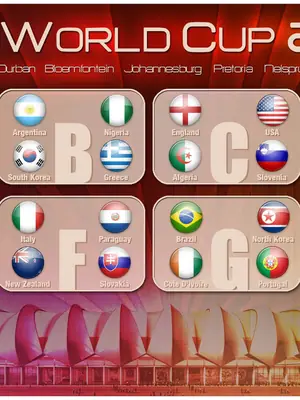
South Africa became the first host nation to go out in the group stage, despite beating France in their last game. The bigger story was the holders. Italy, champions in 2006, finished bottom of a group that also contained Paraguay, New Zealand and Slovakia. France, the beaten finalists of 2006, also went out at the first stage, after a tournament remembered more for the squad's refusal to train at Knysna than for anything on the pitch.
The knockout rounds and two refereeing debates
Two moments from the knockout rounds changed the conversation about technology in football. In the last 16, Frank Lampard's shot against Germany hit the crossbar and bounced clearly over the line, but the goal was not given. England lost 4–1. Goal-line technology was introduced at the next World Cup.
In the quarter-final between Uruguay and Ghana, Luis Suárez stopped a goal-bound header with his hands on the line in the last minute of extra time. He was sent off, Asamoah Gyan hit the crossbar with the penalty, and Uruguay won the shoot-out. Ghana were one kick from becoming the first African side to reach a World Cup semi-final.
Away from the pitch, an octopus called Paul at an aquarium in Oberhausen, Germany, became briefly famous for picking the winners of matches by choosing between two boxes of food marked with flags.
The final at Soccer City
The final was played on 11 July at Soccer City in Johannesburg in front of 84,490 people, Spain against the Netherlands, two countries that had never won the World Cup. It was not the passing match many expected. The English referee Howard Webb showed 14 yellow cards, nine to Dutch players and five to Spanish ones, a record for a World Cup final. In the 28th minute Nigel de Jong caught Xabi Alonso in the chest with a high, studs-up challenge that drew only a yellow card.
The Netherlands had the two best chances of normal time, both to Arjen Robben and both saved by Iker Casillas, the second with a dive at the forward's feet in the 83rd minute. John Heitinga was sent off for a second booking in the 109th minute of extra time, and seven minutes later Andrés Iniesta took a pass from Cesc Fàbregas and scored from the right side of the area. Spain won 1–0. It was their first World Cup, and the first time a European team had won the tournament outside Europe.
Who took the individual awards
Four players finished on five goals: Thomas Müller of Germany, David Villa of Spain, Wesley Sneijder of the Netherlands and Diego Forlán of Uruguay. The Golden Boot went to Müller on assists. Forlán was named the best player of the tournament, Müller the best young player, and Casillas took the Golden Glove as the best goalkeeper.
The library's pages for Andrés Iniesta, David Villa, Wesley Sneijder and Fernando Torres hold wallpapers from around that summer, and the national teams collection includes the Spain side of the period.
Questions about this
Who won the 2010 World Cup?
Spain, who beat the Netherlands 1-0 after extra time in the final at Soccer City, Johannesburg, on 11 July 2010. Andrés Iniesta scored in the 116th minute.
Who won the Golden Boot at the 2010 World Cup?
Thomas Müller of Germany. He finished level on five goals with David Villa, Wesley Sneijder and Diego Forlán and won it on assists.
What was the name of the 2010 World Cup mascot?
Zakumi, a leopard with green hair in South Africa's sporting colours.
What was the 2010 World Cup ball called?
The Adidas Jabulani. Several goalkeepers complained that its flight was hard to read, especially at the high-altitude venues.